Equipment welding repair in Belleville and the Quinte region
When a piece of equipment cracks or breaks a weld, the hard part often isn't the repair itself — it's getting the equipment to a shop. Mobile equipment welding repair brings the welder to the equipment, wherever it sits, so a loader, trailer, or piece of farm machinery doesn't have to be hauled across town.
Call for the fastest answer. Mon-Sat, 7am-7pm for normal callback hours.
Get a clearer answer on the first call.
A good request helps confirm whether mobile welding is practical, what safety details matter, and what photos or measurements will speed up the callback.
- One wide photo, one close-up, and one access photo.
- Steel, stainless, aluminum, cast, or unknown material.
- Belleville-area location, urgency, and whether the item can move.
What customers should know before they call.
What can be repaired on-site
Mobile welding covers a wide range of steel and metal repair in the field: heavy equipment buckets, brackets, frames, and cracked components on loaders and excavators; trailer frames, ramps, hitches, and brackets; farm equipment implements and wear points; and structural or fabricated steel like gates, railings, posts, and brackets that have cracked or failed. The repair approach depends on the metal and the type of failure, since steel and aluminum behave differently.
What kinds of failures get welded
Most equipment welding repairs fall into a few categories: cracks where a weld or the parent metal has split along a high-stress area, breaks where a part has fully separated, worn metal that has thinned over time and needs building back up, and reinforcement for a part that keeps failing in the same spot. A crack that keeps coming back usually points to a load or design issue that a simple re-weld won't solve on its own, which is worth talking through before the work starts.
How the mobile process works
Describe the equipment, the type of metal if you know it, where it's cracked or broken, and where the equipment is located. Photos make a big difference. Some repairs are a clear fit for on-site work and some are better done in a shop depending on access, position, or the nature of the failure, so sharing access details up front means the visit is set up correctly. The welder then arrives with the equipment to make the repair in place, and you see the finished result on your own equipment.
When to call a mobile welder instead of hauling it in.
Calling a mobile welder makes sense when the equipment is hard or expensive to transport, when it's down on a job site and needs to get running again, or when hauling it to a shop would cost more in time and trouble than the repair itself.
If the equipment can be moved easily and there's no rush, a shop is also an option. For heavy or in-use equipment, bringing the welder to it is often the simpler path. Mobile equipment welding repair is available across Belleville and nearby Quinte communities, including Quinte West, Trenton, Napanee, Brighton, Prince Edward County, and Tyendinaga.
Helpful details
- Equipment type and the damaged part
- Type of metal, if known
- Where the equipment is located and access around it
- Photos of the crack, break, or worn area
Clear details help you avoid a wasted trip or wrong repair plan.
You are trying to avoid a missed call, a wrong assumption, or a repair that needs a different process than expected. Clear photos, measurements, access notes, and safety context help the first response focus on whether mobile welding makes sense for your specific job.
If the part is structural, used on the road, connected to equipment, or close to fuel, wiring, hydraulics, or combustible material, say that early. Those details help a welder decide what questions to ask, what preparation may be needed, and whether the item should stop being used until it is reviewed.
Best first message
- What broke and what the item is used for.
- Where the item sits and how a work vehicle can access it.
- Material, size, and thickness if you know them.
- Whether the repair is urgent, structural, or safety-sensitive.
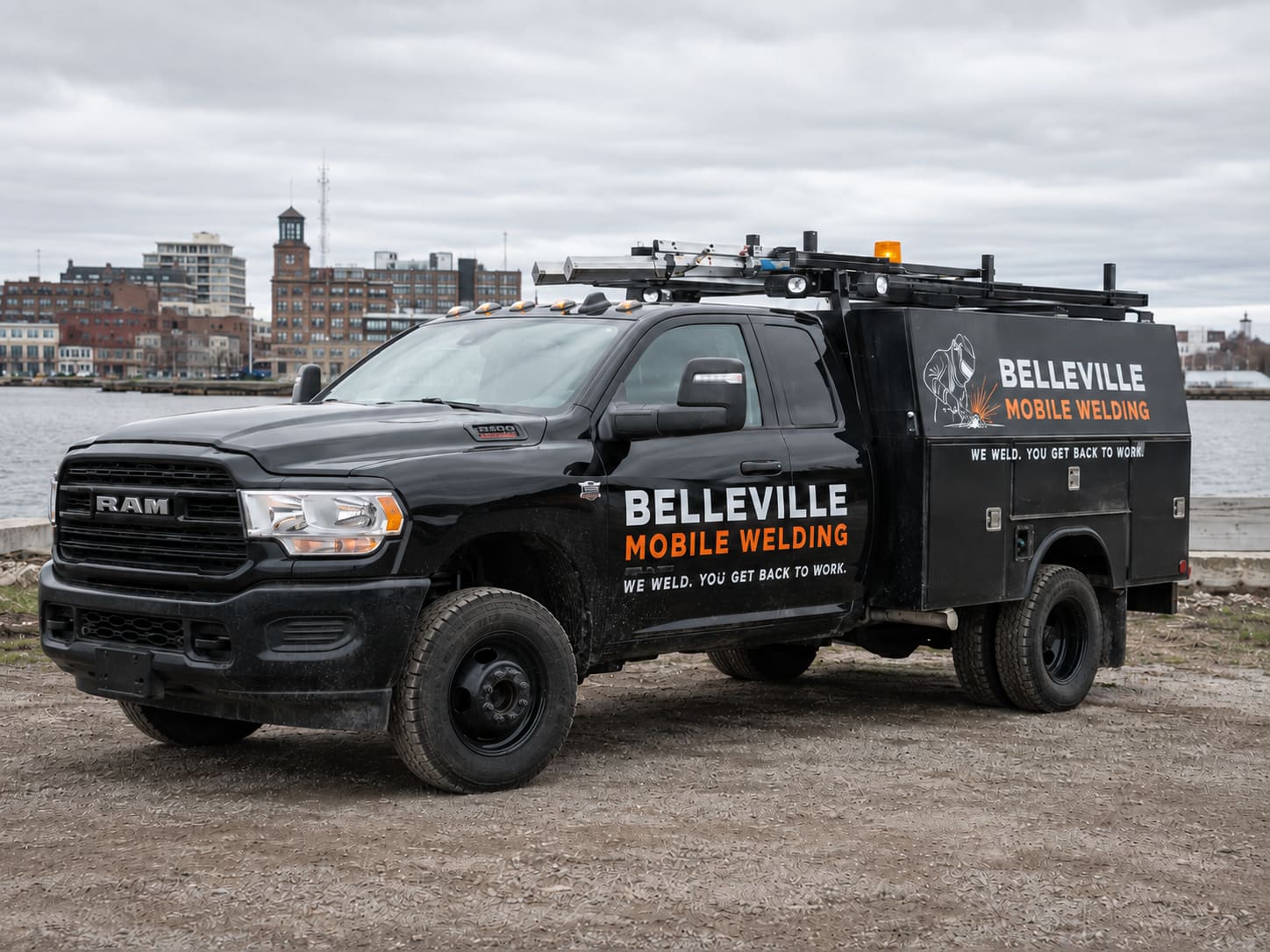
Photos turn a vague request into a clear repair conversation.
Show the full item, the damaged area, and the space around the worksite so the repair can be reviewed with fewer follow-up questions.
Call before you move or keep using the damaged item.
If the repair affects a trailer, machine, bucket, gate, railing, or bracket, call first and describe the basics. Clear photos can come after the call if the damaged part is hard to explain.
Have this ready for the call
- Your location and best callback number.
- What broke and what the item is used for.
- Photos of the full item, close-up damage, and work area.
- Whether the item is safe to move or still in use.
Related Belleville welding pages.
Use the closest page for the job type. The more specific page gives you better guidance on photos, measurements, access notes, and safety details.