Mobile welding service area for Belleville
Mobile welding is local by nature, but the practical service radius depends on job value, urgency, travel time, access, weather, and whether the repair can be done safely on-site.
Call for the fastest answer. Mon-Sat, 7am-7pm for normal callback hours.
Get a clearer answer on the first call.
A good request helps confirm whether mobile welding is practical, what safety details matter, and what photos or measurements will speed up the callback.
- One wide photo, one close-up, and one access photo.
- Steel, stainless, aluminum, cast, or unknown material.
- Belleville-area location, urgency, and whether the item can move.
Service-area fit depends on location and job type.
Belleville first
If you are in Belleville, include the nearest intersection, property type, parking or driveway access, and whether the work is indoors, outdoors, or roadside.
Nearby Quinte requests
If you are in Quinte West, Trenton, Napanee, Brighton, Prince Edward County, or Tyendinaga, include the town, travel context, urgency, and why the item cannot be moved.
Travel and access factors
The request should mention tight driveways, gravel yards, farms, commercial yards, power availability, weather exposure, and whether the item can be moved into a safer work area.
Service-area details that help with Belleville and Quinte jobs.
Your location matters, but so do travel time, setup area, access, urgency, and whether the item can be welded safely where it sits.
Belleville is the first focus. Nearby Quinte West, Trenton, Napanee, Brighton, Prince Edward County, and Tyendinaga requests are easier to review when you explain the worksite and the reason the item cannot be moved.
Helpful details
- Nearest intersection
- Indoor or outdoor work area
- Parking and truck access
- Weather and power availability
Clear details help you avoid a wasted trip or wrong repair plan.
You are trying to avoid a missed call, a wrong assumption, or a repair that needs a different process than expected. Clear photos, measurements, access notes, and safety context help the first response focus on whether mobile welding makes sense for your specific job.
If the part is structural, used on the road, connected to equipment, or close to fuel, wiring, hydraulics, or combustible material, say that early. Those details help a welder decide what questions to ask, what preparation may be needed, and whether the item should stop being used until it is reviewed.
Best first message
- What broke and what the item is used for.
- Where the item sits and how a work vehicle can access it.
- Material, size, and thickness if you know them.
- Whether the repair is urgent, structural, or safety-sensitive.
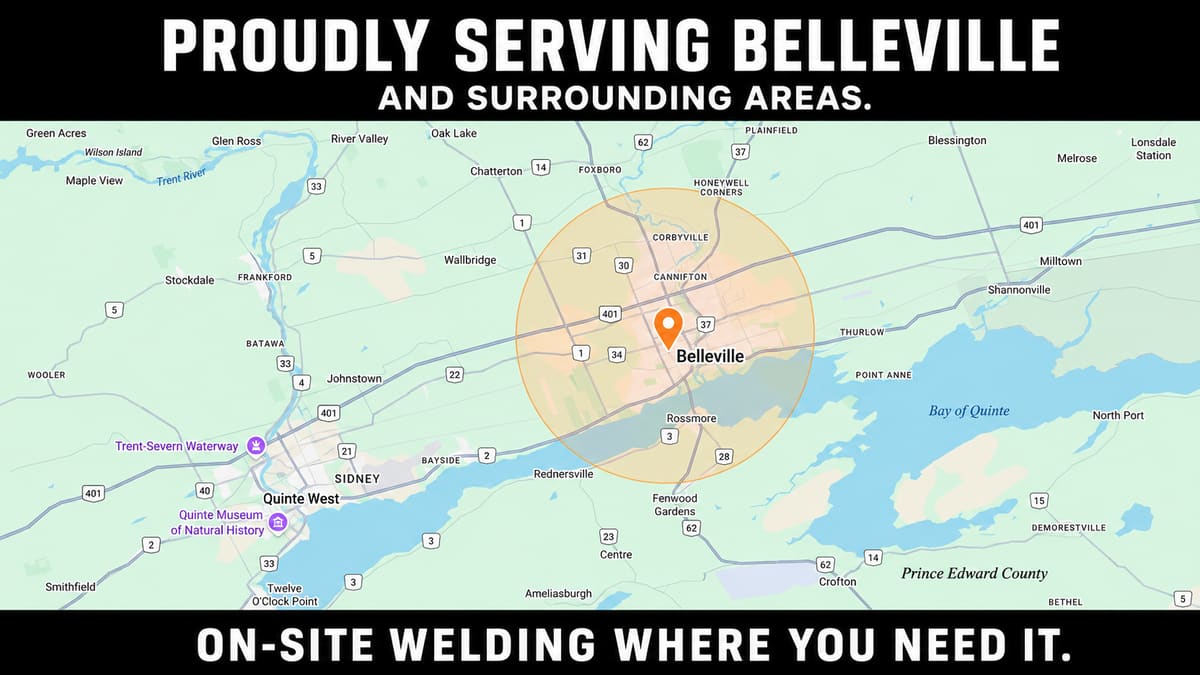
Local help starts with the exact worksite.
Start with the nearest intersection, parking or driveway access, and whether the work is indoors, outdoors, roadside, on a farm, or in a commercial yard.
What customers say about similar mobile welding work.
These collected reviews are shown without pretending there is a star score or total review count. They help customers understand communication, job fit, and on-site repair context.
I had a cracked ramp hinge on my landscaping trailer in Quinte West and needed it fixed before the next job. Belleville Mobile Welding came to the yard, checked the hinge and fr...
We had a farm gate hinge that had pulled away from the post on our property outside Stirling. Belleville Mobile Welding came out, checked the gate swing and post condition, and...
We had an urgent repair needed on a piece of equipment near Napanee and couldn't wait several days for a shop appointment. Belleville Mobile Welding responded quickly, asked the...
Call before you move or keep using the damaged item.
If the repair affects a trailer, machine, bucket, gate, railing, or bracket, call first and describe the basics. Clear photos can come after the call if the damaged part is hard to explain.
Have this ready for the call
- Your location and best callback number.
- What broke and what the item is used for.
- Photos of the full item, close-up damage, and work area.
- Whether the item is safe to move or still in use.
Related Belleville welding pages.
Use the closest page for the job type. The more specific page gives you better guidance on photos, measurements, access notes, and safety details.